
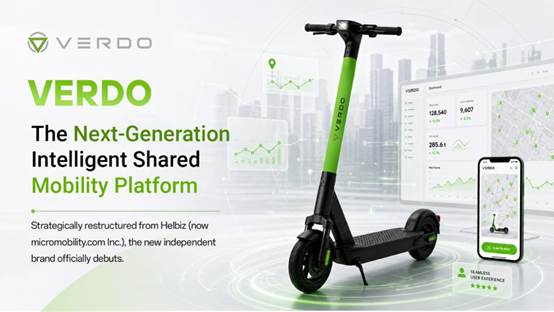
(Joshua Bell)The global micromobility industry is undergoing its most significant structural transformation in more than a decade. According to exclusive industry sources, the U.S. operations of former Helbiz Group (now micromobility.com Inc.) have been fully spun off into an independent entity, VERDO LTD, which has officially commenced operations.
Widely regarded by industry observers as the beginning of the “Micromobility 2.0 Era,” this move represents not only the reinvention of a long-established industry pioneer, but also a critical turning point that Wall Street views as the sector’s transition from a model of aggressive cash-burning expansion to one focused on sustainable profitability and scalable growth.
Breaking Through an Industry at a Crossroads
Over the past decade, shared micromobility has experienced a dramatic cycle of explosive growth followed by widespread market correction. Industry data indicates that the world’s ten largest shared mobility platforms have collectively accumulated losses exceeding US$30 billion, exposing the structural weaknesses of the traditional asset-heavy operating model.
High vehicle acquisition costs, inefficient maintenance systems, and increasingly complex urban regulatory challenges have trapped many operators in a cycle where expansion often leads to greater losses.
Against this backdrop, micromobility.com Inc. embarked on an 18-month strategic restructuring initiative. As one of the earliest pioneers in the micromobility sector, Helbiz established operations across more than 30 countries worldwide. However, like many industry leaders, it faced limitations imposed by legacy operating models.
Following its privatization in 2023, the company’s new leadership team made a decisive strategic choice: focus on core growth markets and establish an independent operating structure capable of unlocking long-term value.
“This is not merely a corporate divestiture—it is a redefinition of the industry’s business model,” said a senior partner at a leading global mobility consulting firm. “The launch of VERDO represents the first credible pathway toward achieving both scale and profitability in micromobility.”
Inheritance and Independence: A New Model for Industry Transformation
As an independent subsidiary, VERDO has established a unique relationship with its parent company characterized by full asset inheritance, complete operational independence, and deep strategic collaboration—a structure that differentiates it from conventional corporate spin-offs.
A Strong Foundation Built on Proven Assets
VERDO is not a startup beginning from scratch. Instead, it inherits a decade of operational expertise and infrastructure from one of the industry’s original innovators.
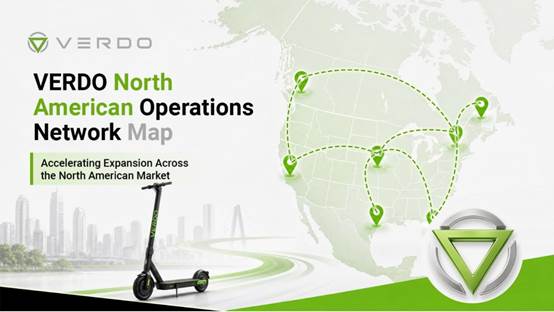
Key assets transferred to VERDO include:
- Exclusive operating licenses across 12 major U.S. cities.
- A connected fleet of more than 100,000 smart vehicles.
- Extensive proprietary operational databases.
- A nationwide offline operations and maintenance network.
VERDO has also secured perpetual rights to several of the parent company’s core technologies, including:
- An AI-powered Digital Twin Dispatch System that has demonstrated a 35% improvement in fleet utilization.
- The V-Link 2.0 Vehicle Connectivity Protocol.
- Advanced predictive maintenance technologies.
In addition, key personnel from the former U.S. operations have transitioned to VERDO, with the management team averaging more than eight years of micromobility industry experience.
Fully Independent Operations
Unlike a traditional subsidiary, VERDO operates with complete autonomy in governance and decision-making.
The company has:
- Successfully completed its independent corporate registration in New York State.
- Obtained a full Money Services Business (MSB) license from the U.S. Treasury Department’s Financial Crimes Enforcement Network (FinCEN) under Registration No. 31000329787643.
- Established independent financial reporting systems and financing channels.
VERDO is currently preparing a US$500 million Series B financing round, intended to support the company’s future expansion into autonomous vehicle and next-generation mobility operations.
The company also maintains independent control over its branding, market strategy, and product development roadmap, enabling rapid responses to the unique demands of the North American market.
Deep Strategic Collaboration
Operational independence does not imply separation.
VERDO and its parent company will continue to collaborate closely through:
- Shared global supply-chain resources that are expected to reduce vehicle and component procurement costs by more than 15%.
- A joint technology innovation platform allowing cross-licensing of R&D achievements and reducing duplicated development expenses.
- Ongoing strategic support from micromobility.com Inc., including international market expertise and access to global partnerships that will facilitate VERDO’s future expansion.
Why Wall Street Is Paying Attention
VERDO’s launch has quickly attracted significant interest from global capital markets. According to sources familiar with the matter, several leading institutional investors are actively evaluating participation in the company’s upcoming Series B financing round.
Investor enthusiasm is driven by several distinctive advantages that differentiate VERDO from traditional shared mobility operators.
A Proven Path to Sustainable Profitability
VERDO has abandoned the conventional asset-heavy ownership model in favor of an innovative framework that combines socialized asset ownership with professionalized operations.
Under this model, investors own the vehicle assets while VERDO provides fleet management, operations, and maintenance services. Revenue generated by the platform is shared between asset owners and operators, creating aligned incentives and significantly reducing capital intensity.
Industry-Leading Regulatory Positioning
VERDO’s regulatory foundation is another major competitive advantage.
By securing a FinCEN-issued MSB license, VERDO has established a compliant framework for conducting asset-related operations across the United States, significantly accelerating its ability to scale into new markets.
“VERDO addresses the two most fundamental challenges facing the micromobility industry today: profitability and compliance,” wrote analysts in a recent industry research report. “We believe VERDO has the potential to emerge as the dominant force in North America’s micromobility sector within the next 12 to 18 months and establish a new benchmark for the global industry.”
The Birth of a New Industry Paradigm
VERDO’s emergence carries significance far beyond the company’s own growth trajectory.
For years, micromobility has been viewed as a capital-intensive industry with uncertain economics. VERDO’s model demonstrates that through business-model innovation, technological advancement, and disciplined operations, micromobility can evolve into a sustainable and profitable sector.
For micromobility.com Inc., the spin-off also represents a pivotal step in its broader strategic transformation. Following the separation, the parent company will increasingly focus on becoming a global micromobility ecosystem holding platform dedicated to investing in and developing next-generation mobility technologies.
With VERDO’s arrival, the global micromobility industry is entering a new chapter. An industry once criticized for its unsustainable economics is reinventing itself through innovation and operational discipline.
The question now is whether VERDO—armed with a decade of industry expertise, a scalable business model, and growing institutional support—can fulfill its promise and lead the sector into a new era of sustainable growth.
The world is watching.